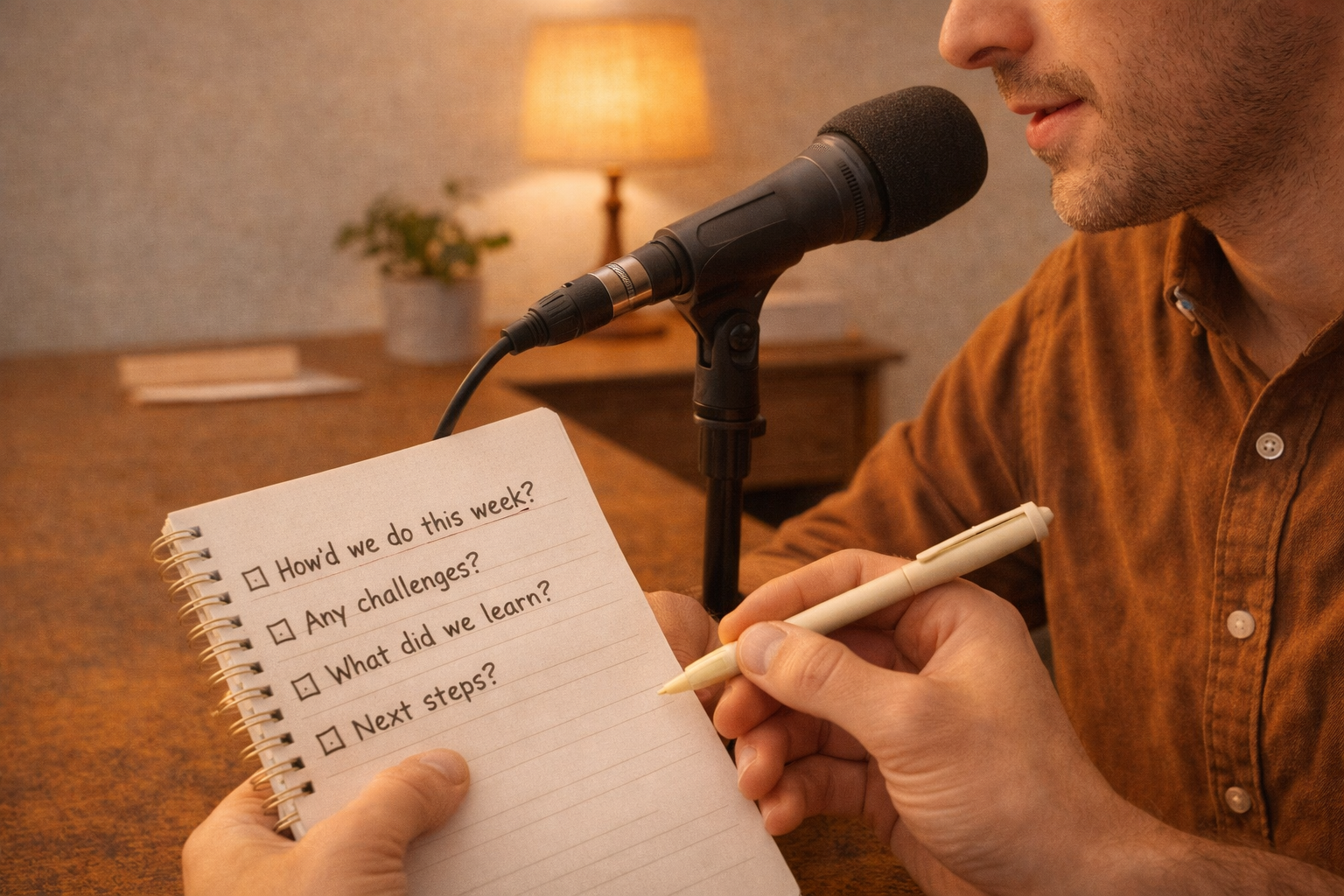
Founders answer the same questions often. Instead of replying from scratch, record your answers once and turn them into shareable content.
The process
- Collect your top five questions
- Record a short answer to each
- Turn each transcript into a mini post
The benefit
You create a reusable library of insights and save time on repeated explanations.
Where to publish
- The company blog
- Investor updates
- Product onboarding emails
If your customers keep asking, turn it into content.
A simple founder template
When you only have a few minutes, use this one‑screen template:
- Decision of the day
- One risk to watch
- One next step with an owner
It is short enough to keep the habit, and clear enough for anyone else to act on it.
What to do on weeks you miss a day
Do not try to backfill perfectly. Record a short “catch‑up” note with two or three bullets. The habit matters more than completeness.
Founder‑friendly publishing flow
If you publish weekly, use your daily notes to build:
- a one‑paragraph investor update
- a short team memo
- a public product log
The content is the same. The audience changes.
The content is the same. The audience changes. Keeping the formats aligned makes publishing feel effortless.
A quick investor update outline
- The win: one sentence
- The risk: one sentence
- The ask: one sentence
If you can fill these three lines, your update is ready.
A final checkpoint
Before you publish, ask two questions:
- Can someone act on this without asking you to clarify?
- Is the next step obvious?
If both are true, your note is ready. Ship it and move on.
A founder‑grade template you can reuse
Use this three‑line format when you are short on time:
- Decision: what you chose today
- Risk: the one thing that could derail it
- Next: the smallest step that moves it forward
It keeps your note short and still gives your team the context they need.
The weekly recap shortcut
On Friday, skim your daily notes and pick three highlights:
- the most important decision
- the biggest lesson
- the next week priority
That becomes the core of your investor update in minutes.
A quick example with real stakes
If you are deciding on a launch date, your update could be:
- Decision: launch next Tuesday for the pilot cohort
- Risk: onboarding still needs a final copy pass
- Next: schedule a 20‑minute review with design tomorrow
This is specific, short, and easy to act on.
A final checkpoint
Before you publish, ask two questions:
- Can someone act on this without asking you to clarify?
- Is the next step obvious?
If both are true, your note is ready. Ship it and move on.
How to apply this in a real week
Pick one day and test the idea from “The Founder Q&A: Record Answers, Publish Insights.” Keep the output small and time‑boxed. When you finish, write down one thing you would change next time. That tiny feedback loop is what turns a nice idea into a working habit. Most workflows fail because they are too big or too vague. The smaller you keep it, the more likely you will repeat it.
A quick self‑review
After you publish, ask yourself:
- Did this feel faster than typing from scratch?
- Could someone else act on it without asking you to clarify?
- Would I repeat this tomorrow?
If the answer is yes, the workflow is working. If not, reduce the steps until it feels easy again.
A realistic expectation to set
The first time you try the workflow in “The Founder Q&A: Record Answers, Publish Insights,” it might feel awkward. That is normal. The second time is faster. By the third time, it starts to feel natural. The goal is not perfection; it is a repeatable system that saves time over a month, not a day.
A small way to make this shareable
When you finish the output, add one line that starts with “Next:” and names the next action. That one line creates momentum and makes the note valuable to someone else. This is the fastest way to turn personal notes into team‑ready updates.
A quick field test
Try this once with a real note today. Keep it short, then look at the output tomorrow. If it still makes sense 24 hours later, the structure is working. If it feels confusing, tighten the first paragraph and clarify the next step.